Project information
Why is MOOReturn necessary?
MOOReturn demonstrates how climate protection and economic development can be approached as a unified concept. Drained peatlands are major sources of greenhouse gases—their rewetting offers enormous potential for CO₂ reduction. At the same time, the use of wetland areas opens up new opportunities for agriculture and regional economic growth.
The project brings together nine partners from academia, industry, and local government who are jointly developing practical solutions—ranging from rewetting to the use of peatland biomass.
MOOReturn is funded by theFederal Ministry of Agriculture, Food, and Home Affairs (BMLEH) and serves as a showcase for sustainable land use in peatland regions.
Story of MOOReturn
The Importance of Peatlands: A Focus on Natural CO₂ Sequesters
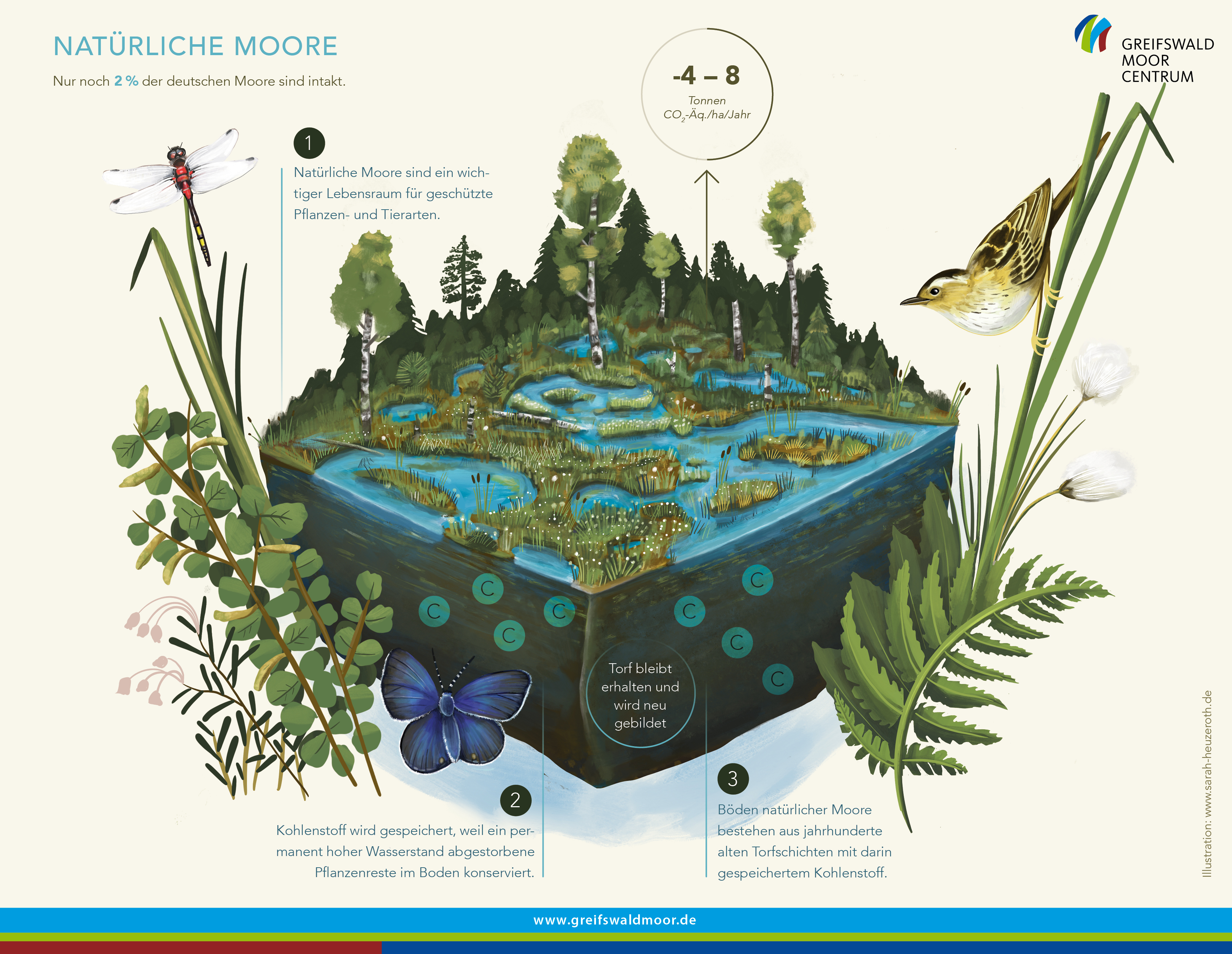
In the past, peatlands were often considered unproductive and were drained on a large scale to make way for agriculture—a practice once seen as a sign of progress. Today, we know that peatlands store vast amounts of carbon accumulated over thousands of years. As long as they remain wet, this carbon stays locked in the soil. When peatlands are drained, however, it is released into the atmosphere as CO₂.
Although peatlands cover only a small portion of the Earth’s land area, they play a crucial role in climate protection. Rewetting restores their function as effective carbon sinks while also supporting valuable habitats for biodiversity.
In many regions, a shift in thinking is underway: water is returning to formerly drained landscapes, and with it, the ecological functions of peatlands.
MOOReturn contributes to this transformation by supporting climate protection through peatland conservation and demonstrating how rewetted peatlands can become part of the solution—ecologically, economically, and regionally.
Learn more about the national peatland conservation and climate protection strategies. →
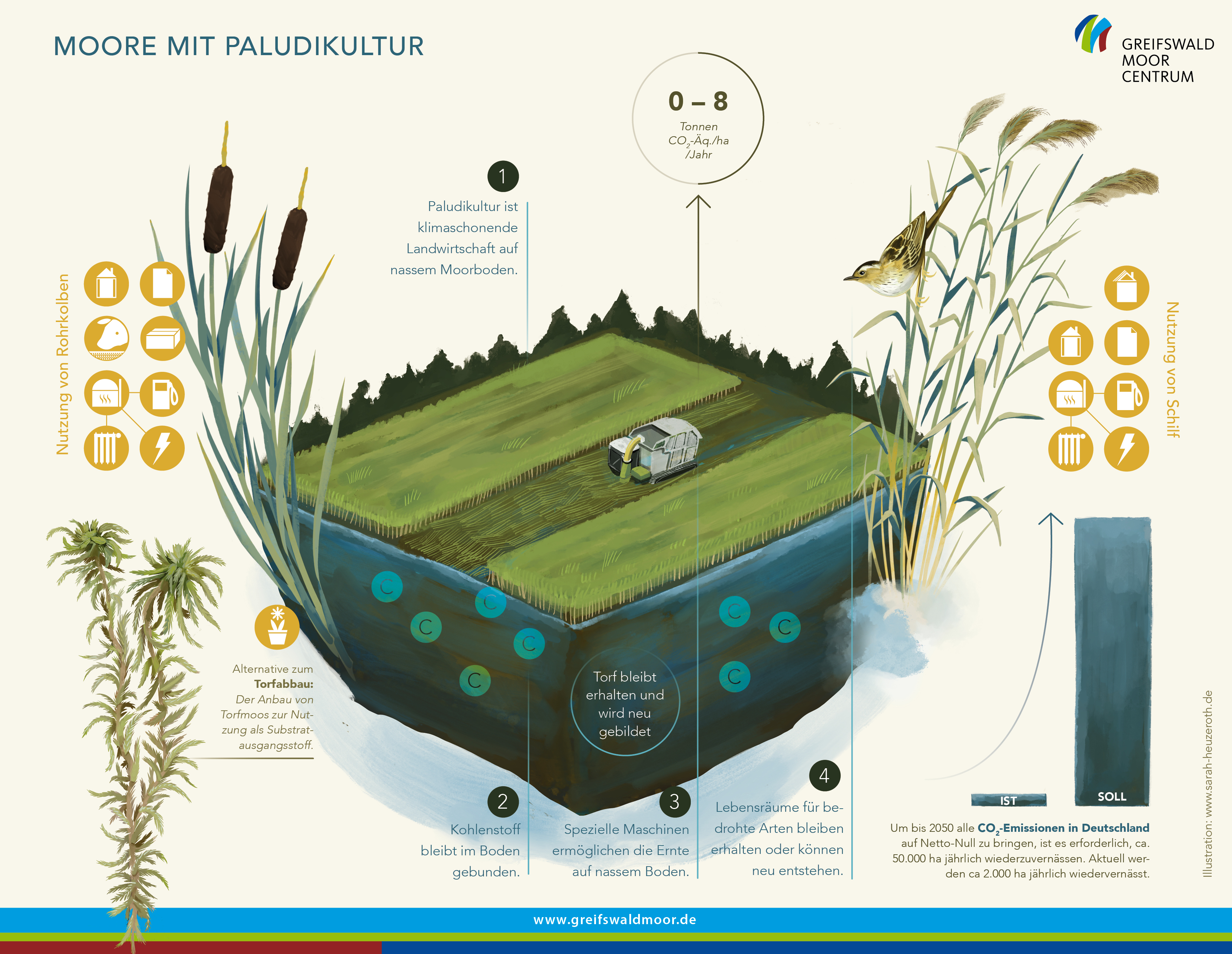
Paludiculture is a solution for climate protection and the sustainable use of restored wetlands. Peatland management helps reduce CO₂ emissions and preserve peat. At the same time, plants such as sedges and rushes grow in the wetlands of Malchin, which can be used as raw materials. In this way, paludiculture combines climate protection with the creation of new regional value.
Learn more about paludiculture. →
Challenges of Paludiculture and Peatland Rewetting
1. Adapting Agricultural Practices
The transition to rewetted peatlands requires a fundamental shift in agricultural practices. Farming systems must adapt to permanently higher water levels, requiring new crops, specialized machinery, and modified harvesting methods.
2. Technical Requirements for Biomass Utilization
Peatland biomass is often moist, heterogeneous, and challenging to process. This creates new requirements for harvesting, storage, transport, and industrial processing, making tailored technologies and innovative process chains essential.
3. Economic Transformation
New value chains for paludiculture products must be established. Since markets for peatland-based products are still emerging, businesses and land managers face economic uncertainties and investment challenges.
4. Social and Planning Coordination
Peatland restoration affects multiple interests, including agriculture, nature conservation, land ownership, and climate protection. Successful implementation therefore requires coordinated planning, dialogue, and participatory decision-making.
Transforming Peatlands in Malchin – A Connected Regional Approach
The rewetting of peatlands marks a fundamental paradigm shift. It represents not only ecological restoration, but also a reorientation of land use for landowners and agricultural businesses.
The MOOReturn project is systematically implementing this transformation through a series of key work packages:
WP1 – Peatland Restoration & Land Management
Large-scale rewetting of peatlands and the development of sustainable land-use concepts for wet peatland management (paludiculture).
WP2 – Biomass Utilization Technologies
Development and demonstration ofthe florafuel® process for the treatment and utilization of peatland biomass, for example in construction materials and industrial applications.
WP3 – Climate Impact & Monitoring
Scientific monitoring and assessment of greenhouse gas emissions, climate impacts, and ecological effects of peatland restoration and use.
WP4 – Communication & Knowledge Transfer
Engagement of relevant stakeholders through dialogue formats such as round tables, field days, information events, and on-site activities to support implementation and exchange.
The close integration of these work packages is key to MOOReturn’s success. Roundtable discussions bring together stakeholders from agriculture, science, public administration, and nature conservation to jointly develop solutions and coordinate measures. Field days and site visits provide practical insights into new land-use approaches, management practices, and technologies.
Step by step, this process creates a shared understanding of opportunities, challenges, and regional needs. Peatlands are not only being revitalized but also managed sustainably. New approaches, such as the harvesting and utilization of peatland biomass, create economic opportunities for sectors including construction and other bio-based industries.
MOOReturn demonstrates how peatland restoration, technology development, scientific monitoring, and stakeholder dialogue can work together to combine climate protection, economic value creation, and regional development.