ETH-Soil Evidence base
Within the ETH-Soil project, the effects of specific biochar-based fertilizer formulations have been tested in practical trials, employing pot experiments, field trials as well as farmer-participatory methods. The results of these experiments are the evidence base for the dissemination of the approach to diverse soil types, altitudes and crops in Oromia and Sidama. Below, you can explore both the individual research projects and the overarching results of the initiative. Each project is presented through a short interview, in which the scientists outline their ideas, methodologies, and key insights.
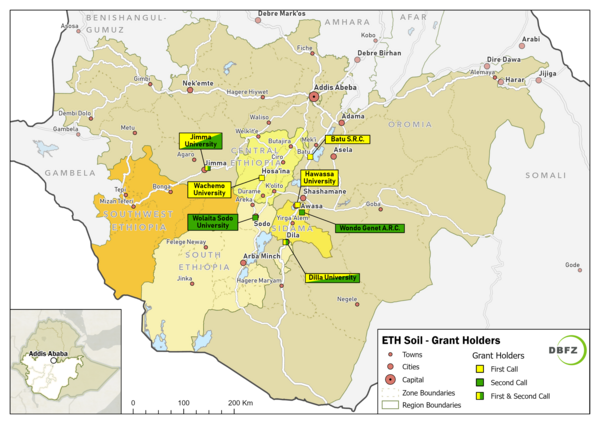
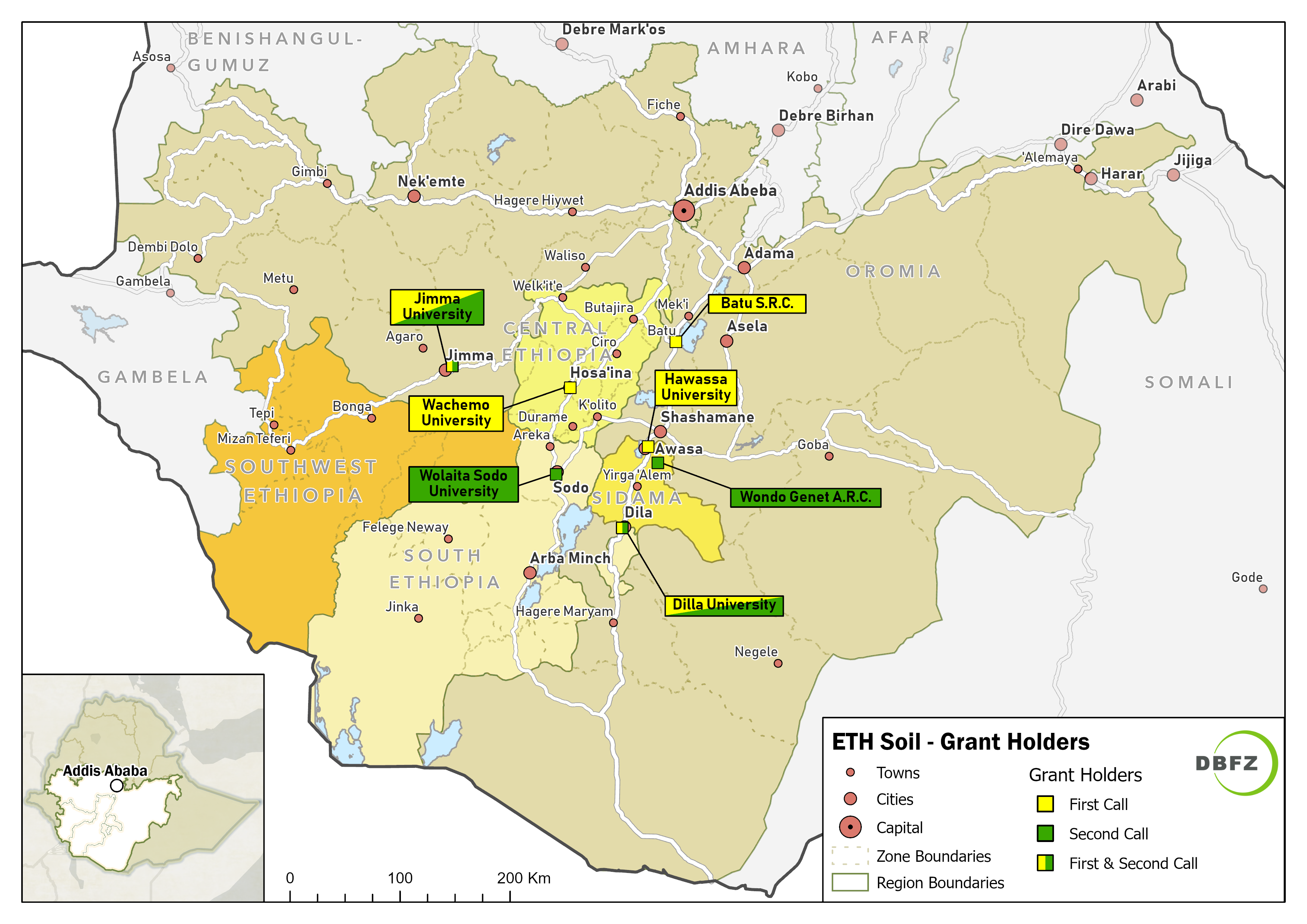
Experiments within the 1st ETH-Soil call
The experiments within the 1st ETH-Soil call were carried out by six teams in 2023 and 2024. Part of the results have been presented at EUBCE 2024 and subsequently published in Biofuels, Bioproducts and Biorefining. You can find the paper here:
Mekonnen, B., Wilske, B., Addisu, B., Nigussie, A., Siegfried, K., Gizachew, S., Yimer, T., Mohammed, B., Ahmed, M., Abera, T., Nebiyu, A., Worku, R., Regassa, A., Firomsa, T., Husien, A., Worku, G., Lema, A., Tilahun, A., Assefa, K., Dume, B., Eshete, G. and Pollex, A. (2025), Biochar-based fertilizers increase crop yields in acidic tropical soils. Biofuels, Bioprod. Bioref., 19: 1124-1142. https://doi.org/10.1002/bbb.2777
Development of an evidence basis for the application of nutrient-loaded biochar on smallholder farms to enhance soil regeneration, increase productivity, strengthen food security, and mitigate climate change
| Scientist | Dr. Abebe Nigussie |
| Institute | Jimma University |
| Duration of the project | 01/08/2023 – 31/12/2024 |
| Location of project implementation | Jimma Zone, Dedo District |
| Type of project | Field experiments (both on-farm and on-station experiments) |
| Crop | Wheat |
| Fertiliser components | Biochar (from coffee husks), Digestate (from cattle manure) |
Interview with Dr. Abebe Nigussie
Biochar based organic-fertilizers for enhanced soil fertility, crop productivity and mitigate climate change: a local solution for global challenge
| Scientist | Dr. Milkiyas Ahmed |
| Institute | Jimma University |
| Location of project implementation | Jimma University |
| Type of project | Greenhouse/Pot and field experiment |
| Crop | Teff |
| Fertiliser components | Biochar (from coffee husks), coffee husks, different manures and bone char |
Interview with Dr. Milkiyas Ahmed
Integrated use of coffee husk biochar and vermicompost on smallholder farms to enhance soil regeneration, increase productivity, strengthen food security, and mitigate climate change in Sidama region, Southern Ethiopia
| Scientist | Dr. Shimelis Gizachew |
| Institute | Hawassa University |
| Location of project implementation | Hula District, Sidama Regional State |
| Type of project | Field trial |
| Crop | Wheat and maize |
| Fertiliser components | Biochar (from coffee husks), vermicompost, compost and mineral fertiliser |
Interview with Dr. Shimelis Gizachew
Integrated effect of Biochar and Bio-slurry compost with NP Fertilizers on soil physic-chemical properties, climate change mitigation, yield components and yield of Sorghum
| Scientist | Tilahun Abera, Reta Worku |
| Institute | Oromia Agricultural Research Institut, Batu Soil Research Center |
| Location of project implementation | Adami Tullu Jido Kombolcha district of East Shewa Zone, Oromia Region |
| Type of project | Pot experiment |
| Crop | Sorghum |
| Fertiliser components | Biochar (from coffee husks), digestate (from biogas plant), mineral nitrogen and phosphorus fertiliser |
Interview with Reta Worku
Smallholder farmers involved preparation and evaluation of biochar-based fertilizers for improved soil fertility management and food barley productivity in Central Ethiopia
| Scientist | Wondimu Tamrat |
| Institute | Wachemo University |
| Location of project implementation | Analemo Woreda, Hadiya Zone, Central Ethiopia |
| Type of project | Field trial |
| Crop | Barley |
| Fertiliser components | Biochar (from cordiana africana wood residues), compost and vermicompost |
Interview with Wondimu Tamrat
Evaluation of biochar-treated enriched amendments for their agronomic effectiveness in acidic soils, in Southern Ethiopia
| Scientist | Dr. Yackob Alemayehu |
| Institute | Dilla University |
| Location of project implementation | Dilla, Gedeo Zone, Southern Ethiopia and Jimma Zone, Oromia |
| Type of project | Pot experiment |
| Crop | Maize and barley |
| Fertiliser components | Biochar (from coffee pulps), vermicompost, liquid manure |
Interview with Dr. Yackob Alemayehu
Experiments within the 2nd ETH-Soil Call
The 2nd ETH-Soil Call focused on smallholder farmer participatory research. All funded project used participatory methods during implementation and evaluation of the experiments. At the moment, the results of one project are published:
Nigussie, A., Tadess, K., Abera, D., Mekonnen, B., Mekuria, R., Desalegn, T., Abafita, R., Abera, T., & Hordofa, M. (2026). Participatory evaluation of biochar-based fertilizer application: Effects on soil properties, yield, and yield components of bread wheat in acidic Nitisols. Agrosystems, Geosciences & Environment, 9, e70309. https://doi.org/10.1002/agg2.70309
Biochar-Based Fertilizer: Challenges and Opportunities for a Widespread Uptake of the Technology by Ethiopian Small-scale Farmers for Increased Grain Productivity
| Scientist | Dr. Ashenafi Nigussie |
| Institute | Wondo Genet Agricultural Research Center, EIAR |
| Location of project implementation | Hula and Teticha districts, Sidama Regional State |
| Type of project | Participatory field experiments |
| Crop | Wheat |
| Fertiliser components | Biochar (from coffee husks) and vermicompost |
Interview with Dr. Ashenafi Nigussie
Blending bioslurry with biochar: Effects on crop production and soil fertility at Jimma Zone, Dedo Woreda.
| Scientist | Dr. Essubalew Getachew |
| Institute | Jimma University |
| Location of project implementation | Dedo Woreda, Jimma Zone, Oromia |
| Type of project | Field trial |
| Crop | Teff |
| Fertiliser components | Biochar (coffee husks), liquid digestate |
Interview mit Dr. Essubalew Getachew
Nutrient Loaded Biochar Production, Characterization, and Optimizing its Management for Soils in Wolaita Area, Southern Ethiopia
| Scientist | Prof. Fanuel Laekemariam |
| Institute | Wolaita Sodo University |
| Location of project implementation | Wolaita Zone, Southern Ethiopia |
| Type of project | Field trial |
| Crop | Wheat and common bean |
| Fertiliser components | Biochar (coffee husks, cordiana africana wood residues), vermicompost, croton leaves and farmyard manure |
Interview with Prof. Fanuel Laekemariam
Participatory Evaluation of Biochar-Based Biofertilizers on Smallholder Farms of Gedeo-Sidama area, Southern Ethiopia
| Scientist | Dr. Yackob Alemayehu |
| Institute | Dilla University |
| Location of project implementation | Sidama |
| Type of project | Field trials |
| Crop | Maize, barley and wheat |
| Fertiliser components | Biochar (coffee pulp), vermicompost, liquid manure |
Interview with Dr. Yackob Alemayehu
ETH-Soil Calls for Research Proposals
Development of an evidence basis for the application of nutrient-loaded biochar on smallholder farms to enhance soil regeneration, increase productivity, strengthen food security, and mitigate climate change
Introduction and background of the call
Agricultural cultivation in Ethiopia takes place primarily on highly fragmented land - with average farm sizes ranging from 0.2 to 2 hectares. Due to overuse, erratic rainfall and soil erosion, food security is one of the country's greatest challenges. Soil acidification occurs with eroded topsoil and depleted soil organic carbon (SOC) stocks, depleted nutrients, alternating drought stress and high rainfall. Many areas are experiencing productivity declines for main staple foods and cash crops. Rather few farmers use agricultural residues for soil improvement - mainly due to strong competition for the use of these residues as animal feed or fuel. However, several Woredas have already been advancing composting and vermicomposting efforts without or alongside other measures targeted to reduce soil erosion and improve soil fertility (intercropping, agro-forestry, etc.). Due to high and currently increasing prices of synthetic fertilizers in Ethiopia, the local production of organic fertilizers gains increasing attention.
“Biochar based fertilizer: challenges and opportunities for a widespread uptake of the technology by Ethiopian smallscale farmers for increased grain productivity”
Introduction and background of the call
Sustainability is innate to agriculture. However, growing population leads to high land use pressure and diminishing resources. The resulting resource competition tends to break the circular use of farm and crop residues, diverting them to seemingly better uses than for the indispensable replenishment of soil fertility. Hence soils are degrading - also because mineral fertilizer is no cure for nutrient depleted soils. On top, tropical climate is a strong force to accelerate soil erosion whereever it finds a leverage.
Across the world and disciplines, science has re-discovered, consented on, and refined agricultural methods that can sustainably recover soil fertility. Among these is the application of biochar-based fertilizer (BBF), which increases and stabilizes soil organic carbon (SOC), microbial activity, nutrient status, water retention capacity, and soil pH. BBF has been introduced by various national and international collaboration projects, and its use has seen an increasing trend in Ethiopia...
Download: Information on the 2nd call